
Hello, my name is Allen Trent. This is my true account of what I have experienced in researching and now manufacturing Trentatrons. If you have any doubts about these devices (most of us do at first) and you have the time, please read the following chronicle of my research and development of these products. Even if you don't purchase my product, it will help guide you to the few vendors out there that have good products and help you stay away from the ones with outlandish claims (such as "works on steel pipes"). Don't expect top notch performance from refrigerator magnets or cheap magnets in plastic cases with tie wraps.
I was doing some research on the Internet when I came across a web page that talked about magnetic water treatment devices. This website had a neutral bias toward them and showed how they made a crude arrangement using Neodymium magnets and plumbers straps. They mentioned many of the claims made for these devices. They stated the following: "The only claim that we can confirm is that magnetically-treated water DID taste different (and better!) when we sampled it in blind taste tests. The difference was far easier to discern when using chlorinated water from town instead of our mountain spring water."
Since I don't buy bottle water typically (refrigerator water is fine with me), the idea of better tasting water did appeal to me. Having an engineering background I was very skeptical of these claims. But OK, that's pretty easy to test, so I did.
14 June 2004:
I purchased a large neodymium ring magnet locally and preceded to thread several feet of tubing around and through it, and then connected it to the water line feeding my refrigerator. I was really surprised that it really did change (and improve) the taste of the water.
So, I did more research where I found studies that backed up the following claims:
-
They prevent the build up of lime scale and corrosion in pipes, water heaters, boilers, and cooling towers and over time will dissolve and remove existing scale. Elimination of lime scale and corrosion from heating elements provides a major reduction in energy usage along with savings from a reduction in maintenance costs.
-
They make the water feel softer and wetter by reducing the water surface tension.
Here are links to different studies made on Magnetic water treatment devices:
Non-ion Exchange Water Treatment
Mitagation of Mineral Fouling in Cooling Towers
US Dept. of Energy Federal Technology Alerts
Still not convinced? Neither was I completely until I considered Magnetic Resonance Imaging. From watching TV or from first hand experience we know that MRI's work and are very valuable medical tools. The basic principle on which they operate is the same principle that makes Magnetic Water Treatment work. Hydrogen (and a few other elements also) have a strong response to magnetic fields.
Other benefits claimed are as follows:
-
Softer skin and softer more manageable hair.
-
Improved soap efficiency and softer laundry.
-
Reduced stains and deposits on laundry and dishes.
-
Pools and Spas require less chemicals and water clarity is improved.
-
Dental tartar and plaque reduction and prevention for us and our pets.
-
Fertilizers and chemicals used in agriculture work better as well as the plants take up the water better.
23 June 2004:
Well, those claims are a little more subjective and harder to document. You can always find positive testimonials on someone's marketing website but you never know how real they are. So, I found a seller on eBay that sells those wrap-around refrigerator magnet type devices. I sent emails out to six of his buyers asking them what their experience had been with those devices. I received these three replies.
One gentleman said he thought they were working but felt he needed stronger magnets.
A reply from one lady said she thought they might be working.
.
The last reply was from a second lady who stated:" My recommendation to any one who asks me, would be don't waste your money. Sorry, just being honest".
Well I had read on the internet that there were some variables that could limit the effectiveness of these devices. What got me excited was that 2 of the 3 people who responded thought they might be working.
So, as any good engineer might do, I decided to build my own magnet systems and see what they would do for me. The hallmark of my life's work has always been over-engineering my designs. Not only did I base my design on the strongest rare-earth (Neodymium) magnets I could find, but also on the best heavy carbon steel frame that I could come up with.
The heavy steel frame is most important. The steel frame shapes and magnifies the magnetic flux inside the mounting frame itself. The Neodymium magnet field is very intense and the steel frame provides shielding which contains the magnet field and also prevents disturbances from outside magnetic fields. Any magnetic water treatment device without a full steel enclosure will not contain it's own magnetic field nor provide shielding from outside magnetic field disturbances. Consider that when you look at some of those units that use car sign material or plastic cases and tie-wraps. How big is their Five Gauss Line?
The maximum gauss rating of the ceramic magnets used in the other MWT devices is 3900 gauss (2500 gauss for the flexible magnets). The ratings of the neodymium magnets that I use are from 12,100 to 13,100 gauss. But, what really counts here is the flux density inside the pipe. Few of the other vendors even discuss flux density inside the pipes. The few that do, do not show actual test measurements inside the pipe. You can view the actual measurements of Trentatron Flux density on the Performance page.
9 July 2004:
All design projects begin with prototype development, as mine did. I contracted with a local millwright to construct the two steel frames that I needed for my prototypes. One assembly is designed for copper pipes up to 1 1/4" in size and PVC pipes up to 1" in size (residential water service). The second assembly is designed for copper pipes 1 1/2" to 2" in size and PVC pipes from 1 1/4" to 2" in size (spa, pool, and commercial service). The magnets were obtained from a local source of Neodymium magnets. Finally I had my steel frames built to my specifications and my magnets. I was now ready to test these devices for myself.
10 July 2004:
The next morning I went out and dug up my flowerbed in front of the water service entrance valves to my house. The hot Texas summer sun was in full force and by the time I got the hole dug and the Trentatron installed I was hot, dirty and sweaty. As soon as I was finished I hit the shower. I was taking my shower thinking my thoughts when suddenly I realized or felt a change in the water. It was a small change but I had felt the water hardness and surface tension change as the magnetized water made it through my plumbing to my shower head.
Thirty one years ago I lived in an old ranch house that was fed by a deep water well. That was the sweetest softest water I have ever lived with. We used small amounts of soap and shampoo but it never seemed that we ever got the soap off, no matter how long we rinsed. Well if that is the type of water you are demanding I can tell you right now that my Trentatrons will not turn hard water into that type of soft water. These devices reduce the water surface tension to make it feel softer and more slippery. But, they do not remove any minerals, they just change the form of the mineral composition and reduce the surface tension.
Since it's claimed that these devices reduces water spotting I gave my bathroom a good cleaning to see how it would work on my shower doors and fixtures. I then went out to my hot tub. My hot tub is a very old tub with none of the modern ozoneators or UV water treatment devices. It only takes a few days after I change the water for it to begin to get cloudy and start to smell funky unless I treat it everyday heavily with spa chemicals. I drained, serviced and re-filled the hot tub with my newly magnetized water. I then installed the TAT-2 model on the water return line of my hot tub.
18 July 2004:
So, what has been my experiences with these new Trentatrons? Just as the gentleman mentioned about his magnet system above, I have noticed the following:
My hair is much softer and more manageable.
My drinking water tastes much better.
My shaves are smoother and with less nicks.
My shower door has stayed cleaner with less spotting.
My skin feels softer and smoother after showers and from being in the hot tub.
My laundry is softer and my whites are brighter (I did not cut back any on the detergent or softener).
My teeth feel cleaner as if I had just had my teeth cleaned.
And most importantly my hot tub water has stayed clear and has not started to smell funky while I used less chemicals but used it more often.
My garden which normally fades out in the hot Texas July sun has re-bounded and is greener and fresher now than before I installed the Trentatrons.
These claims are not nearly as wild and crazy as the claim that you can use magnets to take 3D images of your brain now is it.
19 July 2004:
That just leaves one last claim that I have not addressed. That claim is that they prevent lime scale formation on heating elements, in boilers, and cooling towers thereby saving money on energy and maintenance costs. Calcium deposits on heating flues and elements are insulators which requires additional use of energy to heat the same amount of water. The deposits require additional maintenance to prevent premature failures of heaters and boilers.
Just this week I noticed a plumber over at my next door neighbors house. He was replacing the hot water heater. I have lived in this house since February of 1982 and it was new when I moved in. The house next door was sold the next year and it is now on it's 4th hot water heater (house was a rental unit until 1997 which meant no maintenance on the hot water heaters).
I replaced my original hot water heater in July of 1998 when it finally started to leak. Prior to this I worked on the original heater many times, replacing burnt out heating elements that were caked with calcium deposits, replacing the thermostat/overload units, and draining heavy calcium buildup from the bottom of the tank.
My present heater is designed to help fight deposit build up in the bottom of the tank. So far I have not had any problems with it and I still drain the tank at least once a year to remove the buildup that does occur even on this lifetime type tank design. I drained the tank the day (10 July 2004) I installed the Trentatrons and even attempted to remove the heating elements so I could check them and remove the calcite buildup. I wanted to take photos of them, clean them, and then check them later on to see how well the Trentatrons were working for me inside the hot water heater. Unfortunately, I wasn't able to get the heating element out. It was stuck or installed so tightly that my element tool would not break them loose. I am now depending on the Trentatron to remove the calcite from this heating element for me.
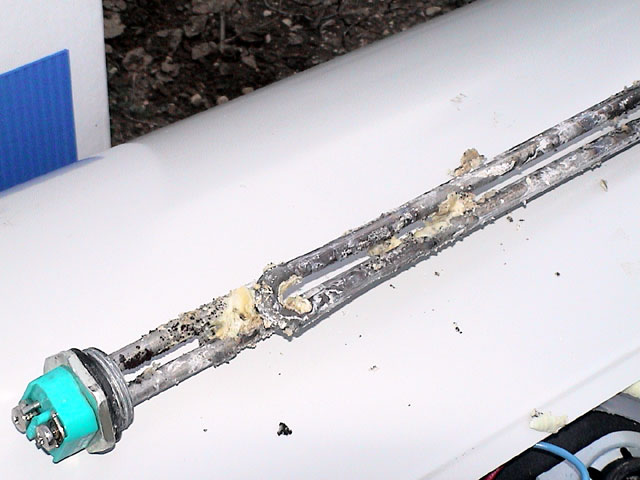
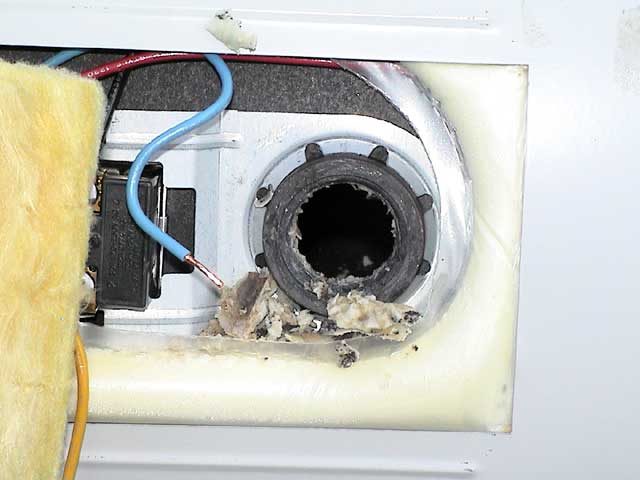
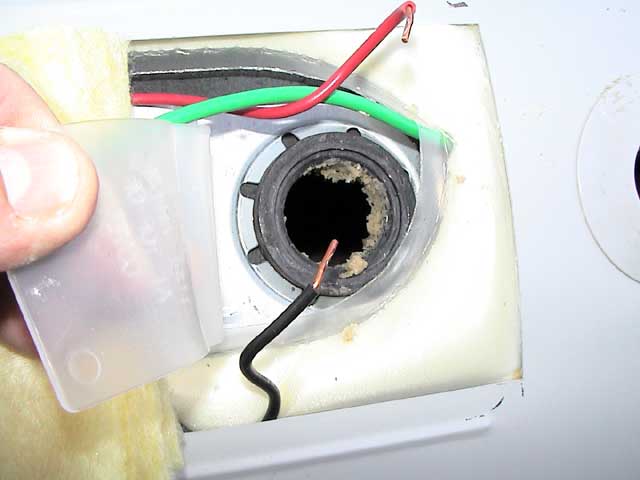
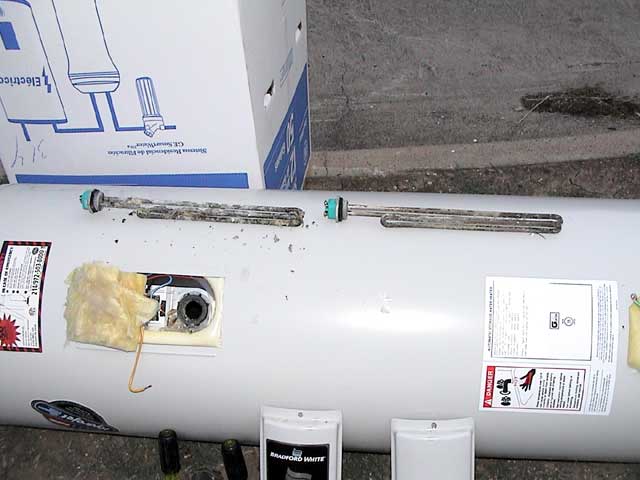
I finally was able to talk to my neighbor about his hot water heater. The water heater he just replaced was installed three years ago. It began to rattle and bang when it was working. He was advised that he needed to drain it to remove the sediment. He drained the heater which only made the condition worse. He spent $ 530 having this 3 year old water heater removed and a new heater installed. The day it was removed I went over to the dead heater and removed the heater elements and took the following photos of them:
Click on image for full size view then use back button to return
Both elements were caked with scale with the upper element being in far worse condition. In the second image you can see the scale that scrapped off the element as I removed it from the heater. Installation of one Trentatron unit would have prevented this problem at fraction of the cost. This heater could easily have been saved by cleaning the heater elements, draining and flushing the tank thoroughly, and installing a Trentatron to prevent further lime scale buildup.
26 July 2004:
Well after talking to my neighbor about his heater I decided that I REALLY needed to take a look at my heater elements since they had been in service twice as long as his. Once more I drained my hot water heater. Holy smoke where did all that crap (sediment) come from, especially that green stuff? I just drained my heater 16 days ago when I installed the Trentatrons and I didn't have nearly as much sediment come out as I did today. Well ,try as I might that top element just wouldn't budge. But, I was able to get the bottom element out. The bottom element was rough to the touch from scale but it had no buildup except right at the screw base. There it had a small amount of the green stuff built up between the electrodes. Here are photos of sediment from the second draining, the lower element, and some of the lime scale that had been removed from the elements in just 16 days of Trentatron use.
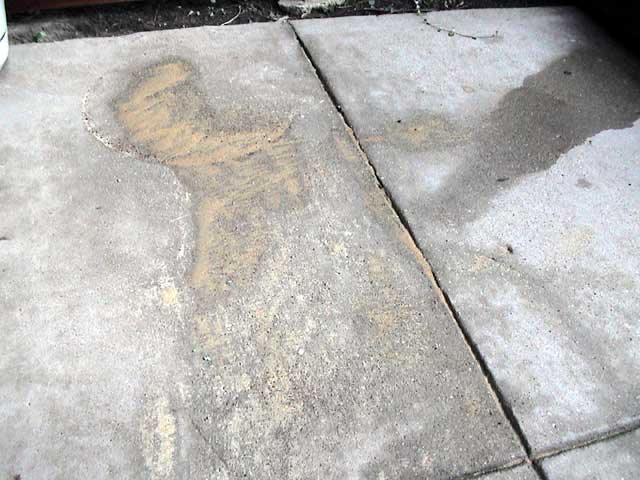
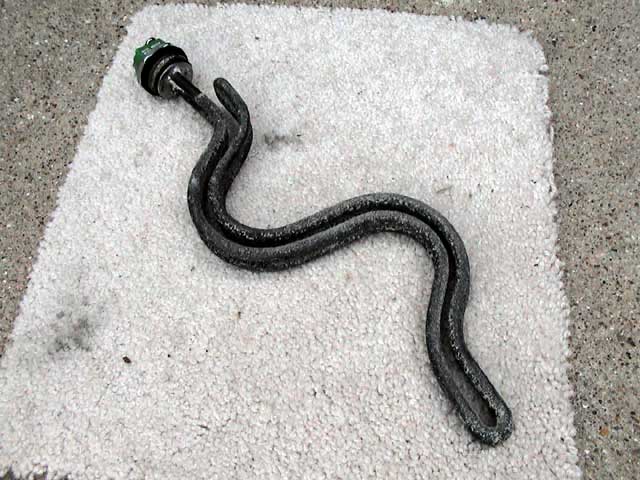
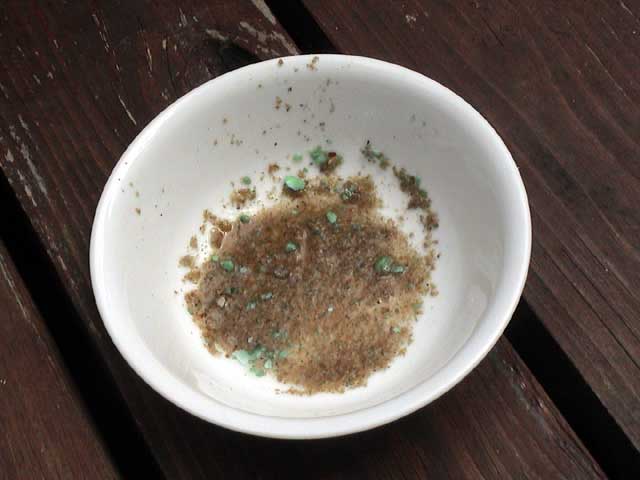
Click on image for full size view then use back button to return
The only conclusion I can come to is that my Trentatrons have been doing their job of preventing and eliminating existing lime scale. I had a heavy build up of new sediment that included a noticeable amount of the green scale. The green scale came off of the heating elements. Two weeks ago I had only a few small pieces of the green scale that came out of the heater on the first draining and flushing.
29 July 2004:
Today I installed a booster Trentatron on the hot water pipe coming out of my hot water heater. It seemed to really help with the laundry and I am still amazed at how soft and manageable my hair has become.
4 August 2004:
Last year I replaced the Master Bath Tub with a fiberglass tub that had scoring in the bottom as an anti-slip feature. What it really did was build up an ugly stain in all the surface grooves in the bottom of the tub. Nothing would touch this stuff until today. I noticed that all the grooves near the drain were shiny white again. With a little help then from Tilex I was able to clean shiny white, the entire anti-slip surface.
14 August 2004:
My tub has stayed relatively clean and white and is now a breeze to clean. Now I have also noticed the tile areas where my shower head sprays the magnetized water. The water has scoured the tile and grout clean of 22 years of use. The buildup beyond the direct spray areas is also melting away. I just can't believe that my new tub no longer has that ugly dirty stain in the bottom of it. Comet cleanser and Tilex wouldn't touch that stain but magnetized water simply melted it away. I had fought that stain for the longest time, then given up, and now it has simply melted away.
23 August 2004:
My kitchen sink drain has run slow for many years now. If I wasn't careful, the disposal would shoot waste over and up into my other sink when I used it. Well, I have now realized that I no longer have this problem. The disposal is no longer sending waste over into the other sink. Sinks drain like they did 22 years ago. Amazing!
11 September 2004:
The latest amazing story I have
regarding these devices came yesterday. I forced some
skeptical friends of mine to allow me to put one of these
devices on their swimming pool/spa system. I did not have my
camera with me so I asked that they take a photo of the tile
work with their digital camera. It had significant scale and
stain buildup above the water line. OK, it was put on their "
To Do" List. That was two weeks ago. I called yesterday to get
an update on my magnets. The first thing my friend said was
that she was sorry. She had not gone out in time and taken the
requested "before" photo. In less than 3 days all the stain and
scale deposits on the pool tile was gone, so no "before" photo
was taken. Then she was REALLY interested in knowing how these
things do what they do. She's a convert now also.
18 November 2009:
Well as you can see I haven't kept this page up to date. It's better to hear from what my customers have to say about the performance of the Trentatron Magnetic Water Conditioners. Take a look at the testimonials from customers on our Testimonial Page.
Trentatronics © 2024