Summer
Sales Specials
Standard Residential Package with
3 TAT-1
Free US Shipping
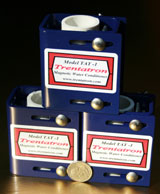
Three TAT-1
$ 219.99
Sales Specials
Standard Residential Package with
3 TAT-1
Free US Shipping
Three TAT-1
$ 219.99
Magnetic Water/Fluid Conditioners have been around for much longer than most people are aware. They have now been used worldwide for over a century in both residential and industrial applications.
There are at least 80 patents filed with the US Patent Office just for "Permanent Magnet Fluid Conditioners". One of the first patents on this science was US Patent No. 531,183*, which was filed October 17, 1890 and was granted Dec 18, 1894. One of the newest patents granted in this area is US Patent No. 6,716,346* which was granted April 4, 2004. So these devices have been in use now for 115 years and there are still new patents being applied for. There is a whole other group of patents for these devices that use electro-magnetics in place permanent magnets.
If you do a search for "magnetic water conditioners" you will find (have found) many vendors of these devices that provide explanations of the science behind them (some better than others). What you typically will not find is any real specifications by which you can compare the products of the different vendors of these devices. What is even worse you will typically find statements that says that what ever their competitors are doing just will not work. These statements are just bald face lies that are not backed up by any scientific test data.
HYDROGEN HAS THE STRONGEST RESPONSE TO A MAGNETIC FIELD OF ALL THE ELEMENTS AND IS THE BASIS ON WHICH MAGNETIC RESONANT IMAGING (MRI's) WORKS. Water will respond to any magnetic field it encounters, regardless of how the magnetic field is generated. It does not matter whether permanent magnets, electro-magnets, or superconducting magnets are used to generate the magnetic field. It does not matter whether the magnetic field is generated externally or internally. MRI scanners employ an externally generated magnetic field into which our bodies are placed. Is there any doubt that MRI technology works??? One vendor tells us that clamp on devices (external fields) won't work. Another tells us that magnets that attract won't work. Then another tells us that if the magnets are "too powerful" they won't work. Just keep one thing in mind. THE STRONGER THE FIELD INSIDE THE PIPE, THE STRONGER THE RESPONSE!!
There are only three things that determine how well these devices work. The methods and materials that are used in their construction determine these three things. The three things you need to know and compare are as follows:
Flux Density and Contact Time have equal influence on the fluid stream. Doubling either one will double the total influence upon the fluid stream, up to the point of saturation. The main difference between the 80 some odd patents on these devices is the Magnetic Field Configuration and the type of material used in their construction. Of course, each vendor claims their configuration is the ONLY one that works. The problem we have with these devices is the lack of a method to directly measure their performance. This opens up the field to wild marketing claims that have no basis in fact. So lets take a closer look at these three things:
Flux Density inside the pipe can be measured with a DC Gauss meter (Magnetometer). If your plumbing is 3/4" Copper Pipe, you want to know what flux density each device will produce inside your pipe (peak and minimum). One thing to remember is that the Flux Density inside the pipe is ALWAYS less than the Gauss Rating of the magnetic material employed. I am sorry, it does not matter how many magnets you have. If you have 6 N30 Grade 11,000 Gauss Neodymium Magnets you DO NOT HAVE 66,000 Gauss. It's still just 11,000 Gauss magnet material and the flux density inside the pipe will be a lot less than that.
An indirect way of comparing the different devices for this important parameter is to compare the "Pull Force" of the magnets that they use. A large ceramic magnet may not have a higher Pull Force than a small Neodymium rare-earth magnet. While size does matter the Neodymium rare earth magnets have a much higher Magnetic Flux Rating.
There is a direct relationship between the Flux Density inside the pipe and the Pull Force per square inch of the magnets that are used. The Pull Force number takes into account the size and shape of the magnet along with the flux rating of the material from which it is made.
The formula for finding the Pull Force of a cube or bar magnet is as follows:
Pull Force = 0.576 x Br² x (Th) x √‾A where
Br = Flux Rating in KiloGauss
Th = Thickness of Magnetized Surfaces in inches
A = Surface Area (L x W) in inches
A Grade 8 Ceramic Magnet (3,900 Gauss material) that is 4 Inch Long, 1 Inch Wide, and 1 Inch Thick will have a Pull Force as follows:
Pull Force = 0.576 x Br² x (Th) x √‾A
= 0.576 x (3.9)² x (1) x √‾4
= 0.576 x 15.21 x 1 x 2
Pull Force = 17.52 Pounds
That translates into 4.38 Pounds of Pull Force per Square Inch (17.52 lb. ÷ 4")
A N42 Grade Neodymium Magnet that is 2" Long, 1 Inch Wide and .5 Inches Thick will have a Pull Force as follows:
Pull Force = 0.576 x Br² x (Th) x √‾A
= 0.576 x (13.2)² x (.5) x √‾2
= 0.576 x 174.24 x .5 x 1.414
Pull Force = 70.96 Pounds
That translates into 35.48 Pounds of Pull Force per Square Inch (70.96 lb. ÷ 2").
So this Neodymium magnet that is half as long and half as thick as the large Ceramic Magnet has a Pull Force per square inch that is 8.1 times higher than the larger Ceramic magnet.
But, pull force of the magnet is only part of what determines flux density "inside the pipe". What is equally important in achieving a high flux density is the Magnetic Field Configuration and the mounting frame construction.
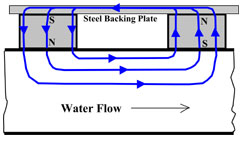
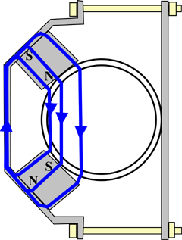
Magnetic Field Configuration and construction materials used is where the 80 some odd patents on these devices comes in to play. A few of the different magnet configurations are shown below:
| In this configuration two magnets are mounted to a steel back plate with magnetic poles as shown. This magnet configuration produces magnetic flux lines that are oriented in the same direction as the water flow. This design produces uneven flux density across the section of the pipe and it is concentrated where the magnets are closes to one another. It does provide a low reluctance return path for the magnetic flux through the steel plate. |
|
| In this
configuration two magnets are mounted on a sheet metal frame,
that fits over the pipe. A non-magnetic blank plate is used on
the bottom side of the pipe for attachment. This magnet
configuration produces magnetic flux lines that cut across the
direction of the water flow. But this design also produces
uneven flux density across the section of the pipe and it is
concentrated where the magnets are closes to one another.
It does provide a low reluctance return path for the magnetic
flux through the sheet metal plate. When flux density measurements were taken on the GMX 800 on a 1 inch copper pipe, the minimum flux density measured was 476 Gauss. Click on the following link for the complete test data and photos taken. Model GMX 800 cost = $ 189.00
|
|
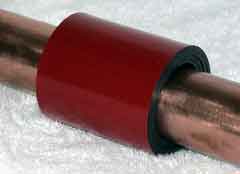
| The wildest
magnetic field configuration comes from
US Patent Number 6641725 for the flexible magnet
wraps. This patent claims 14 different ways of making
these flex magnets. Their current product on the market
is based on their Claim 4 in the patent application. "
An apparatus as in claim 1,
wherein said flexible magnet is wrapped around said conduit,
with said flexible magnet having multiple south and north
poles directed generally radially toward the central axis and
multiple south and north poles directed generally away from
said central axis." The minimum flux density (which is in the center of the pipe) is ZERO Gauss. Yes that right, zero. Click on the following link for the complete test data and photos taken. |
|
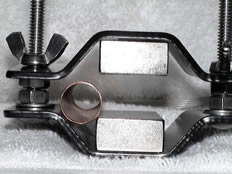
| You
can now find various
designs on the market these
days that employ Neodymium magnets. There are US made
units and also Chinese copies of this design. While the
magnets themselves are good quality, this design lacks the
heavy steel frame of the Trentatron design. The result
is a much lower flux density inside the pipe using the same
size magnets.
Click on the following link for the complete test data and
photos taken.
|
|
|
Electro - Magnetic Water Conditioners There are several different vendors of the Electro-Magnetic type water conditioners. All of these vendors use the same basic approach to water treatment. These units consist of an AC Power module, the electronics box, and a length of insulated wire. You wrap the wire around you pipe 40 times or more creating what is called "a solenoid". Electrical current flowing through the wire will induce a magnetic field inside of this "solenoid". In most units the electronics box output is a low voltage/low current square wave that sweeps in frequency from 1 KHz up to 10 KHz. Some vendor units only consume 2.5 watts of power. The highest wattage units consume only 10 watts. That's just not very much power to be trying to generate magnetic fields with. Consider that a small night light draws 4 watts of power. Now the big question is "Do they work"? The answer seems to be that do work to some degree. These companies would not still be in business and have repeat customers if they did not work. Our DC Gauss Meter will not read the AC field strength that these devices produce. So no attempt will be made to try measure or estimate their field strength inside the pipe, as has been done with the other permanent magnet designs. The power consumption of these devices tells us that they have a very weak flux field. The biggest question is why anyone would choose this technology over our permanent magnet design. To use these devices you must have a power outlet close by. You need to mount the electronics box somewhere. And then you have to wrap the signal cable 40 times or more around your water line creating a solenoid around the water pipe. The typical cost of these devices is 500 to a 1,000 dollars. And like all electronic equipment, sooner or later it's going to stop working. So in summary these electro-magnetic units cost a lot more, have far less field strength inside the pipe, are far more difficult to install, require AC power to work, and sooner or later will fail. Be smart, save money, and keep your life simple and easy by installing our permanent magnet units instead.
|
|
|
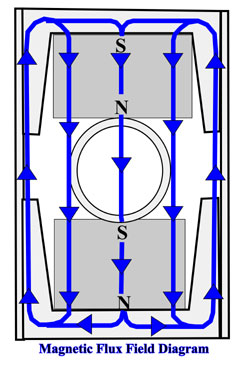
Trentatrons
use a patented design
that places two magnets in an attracting configuration which
are mounted on opposite sides of the pipe. They are built
with a Hot Rolled Carbon Steel frame. This magnet
configuration produces magnetic flux lines that cut across the
direction of the water flow. This design produces
an even flux density across the entire section of the
pipe. It provides a very low reluctance return path for
the magnetic flux through the heavy steel frame. The
large Neodymium Rare-Earth Magnets combined with the heavy
steel frame produces a flux density inside the pipe that is 6
times as powerful as the GMX models. Yes, better
components do make a better product.
1 Model TAT-2 cost = $ 119.99 2 Model GMX 800 cost = $ 378.00
That's over 2 times the cost for one sixth the power.
|
|
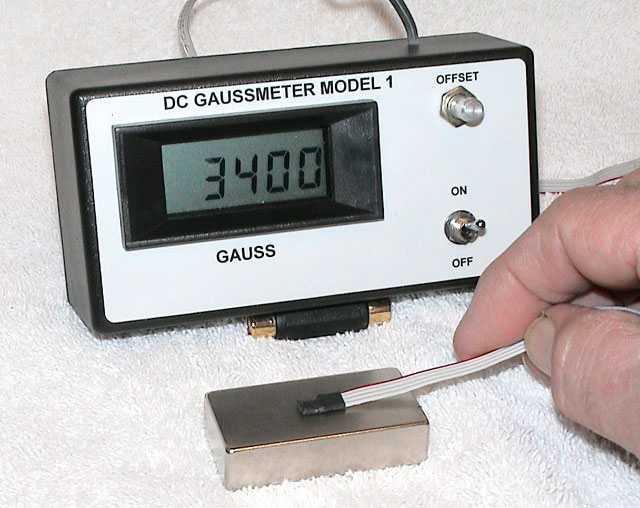
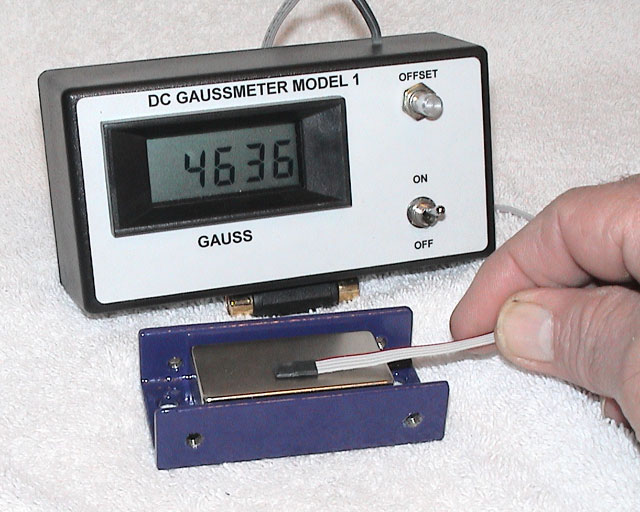
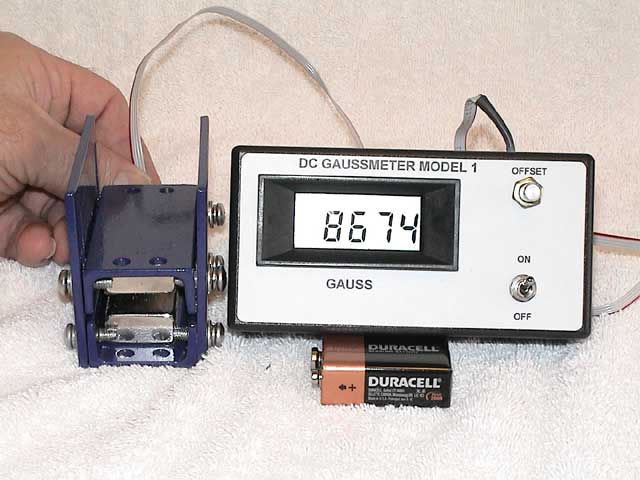
The material from which it is constructed is as important as the field alignment itself. Ferromagnetic materials such as iron and steel provide a "low reluctance path" for magnetic flux just as copper or gold provides a "low resistance path" for electrical current.
Any device that provides a "low reluctance return path" for the magnetic flux will see up to a 50% increase in field density. You can see this effect in these three photos. The bare N42 magnet only measures 3,400 Gauss with the Gaussmeter. This is 13,200Gauss magnet material yet it only reads 3,400 Gauss on it's surface. Remember, the flux density inside the pipe is always less than the material rating. Now notice what happens when we place this magnet in a steel channel and then in a complete heavy steel frame.
|
|
|
|
So as you can see the heavy steel frame makes a dramatic difference in the Flux Density inside the pipe. The Trentatrons heavy steel frame provides a 250% increase over the flux reading of a bare magnet. Any vendor (and there are many) that use plastic cases and tie-wraps to mount cheap ceramic magnets onto your pipes or refrigerator magnet materials are more interested in making a buck than providing you the consumer with complete information about their product..
Contact Time is of course the length of time the fluid stream is exposed to the magnetic field. The contact time is determined by the velocity of the fluid stream and the length of the magnetic field. The velocity of the water is determined by flow rate, water pressure, friction losses, and pipe diameter. Some vendors play games with this important parameter also. One vendor claims eleven inches of magnetic field contact with the pipe but does not provide any information about their magnets length, the number of magnets they use, or the size of the magnets they use. Just like the flux density, contact time is important stuff. Beware of any vendors claim about contact time that you can not confirm yourself by knowing the length and number of the magnets used in their devices.
So in summary, you should disregard any vendors Gauss rating claims that are not measured values "inside the pipe". Find out the actual number and size of the magnets that they use. The Pull Force number of the magnets is very valuable in comparing between vendor devices and the more steel the better.
Remember:
NO STEEL Frame = CHEAP WIMPY PRODUCT
SHEET METAL Frame = BETTER PRODUCT
HEAVY STEEL Frame = BEST PERFORMING PRODUCT
* You can look at this patent online if you wish. Just go to US Patent Office Patent Number Search and enter the Patent Number. If you can't see the images/text you need to click on their help tab. A special tiff viewer is needed. It provides a link to download the viewer software.
Trentatronics © 2015